Hairise Provides Modular Belt, Slat Conveyor Chain And Automatic Conveyor System Solutions Since 2004.
Language
Hairise Provides Modular Belt, Slat Conveyor Chain And Automatic Conveyor System Solutions Since 2004.
Have you ever wondered how the factories can move their products up and down and not take much floor space? A spiral conveyor comes in there. It is smart equipment that frees up space and maintains the flow of production.
This system could become your new best friend in case you have a warehouse, a factory or a packaging line that requires things to be transferred from one level to another. This guide discusses how spiral conveyor systems operate, what makes them unique and where they might be most useful. Read on to learn more.
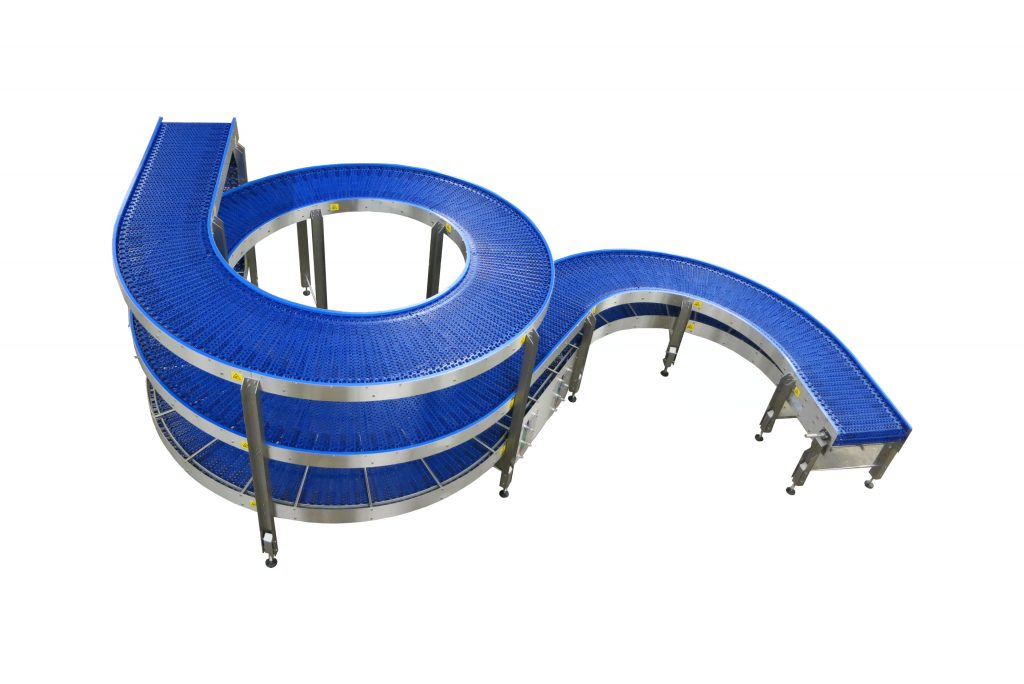
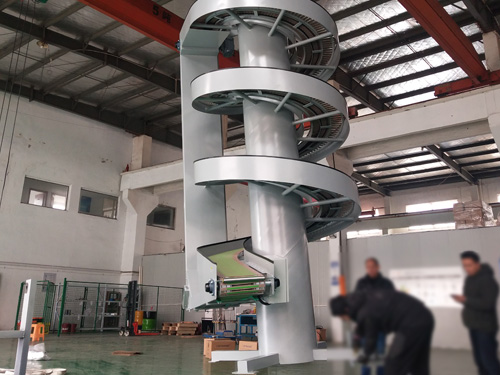
A spiraling conveyor is perceived as precisely what the name depicts: a conveyor to move products in a spiraling manner. It transports items upwards or downwards through a circular route instead of being straight as the regular conveyors do. That’s how it saves space and keeps things moving vertically.
It’s all about the spiral path. The conveyor is built around a center column. A belt or slat system wraps around this column in a rising or falling spiral. When the motor runs, the belt moves products slowly and steadily up or down the path.
● The motor powers the belt or chain.
● The belt carries products along the spiral track.
● The items move smoothly without tipping or sliding.
● Gravity may assist when moving down, reducing energy use.
Simple, right? But the design is smart; it handles elevation change without extra machines or a big footprint.
● Center support column: The structure around which the conveyor turns.
● Spiral belt or chain: The moving surface for carrying products.
● Drive unit: Powers the movement.
● Infeed/outfeed points: Where items enter and exit the conveyor.
And guess what? Most spiral conveyor systems are modular, so they’re easy to install, adjust, or move when needed.
So why are these systems so popular in factories and warehouses? Let’s take a look at the biggest perks of using a spiral conveyor belt:
This is a huge win, especially if your space is tight. Since the spiral conveyor goes up instead of out, you don’t need long straight belts or extra machines to move products between levels. That means more room for other equipment, workers, or storage. You can do more with less space and that’s always a smart move.
These systems move things in a smooth and balanced manner. It is especially ideal when you deal with fragile items such as glass bottles, electronic gadgets, snack boxes or any other item that can fall or spill. The spiral movement prevents things from sliding or jamming in the line even when the line is moving at high speed.
Got a busy line? No problem. The spiral conveyor belts are constructed with nonstop operating systems. They are able to deal with a continuous flow of products without congesting the line. They move at a constant rate, all whether it is ten boxes or one hundred of them.
If your line is pushing the items downward, then the conveyor works under the power of gravity. This implies that the motor does not need to work so hard and you save on utility bills. It is a minor thing that matters in the long run-particularly when the system is constantly operating throughout the day.
Nobody likes machines that break down all the time. Good news: spiral conveyors are known for being reliable and low-maintenance. Most just need quick inspections, some cleaning, and occasional part checks. No need to shut down your whole line for repairs.
Whether you're working in a big warehouse or a small corner of a production room, these systems fit right in. You can set them up between floors, between machines, or even in the middle of a compact assembly area. They’re available in different sizes and heights, so you can pick the one that fits your space the best.
You’ll find spiral conveyor systems in all kinds of industries. They’re especially useful where space is tight or where elevation changes are needed.
● Food and beverage lines: Move packaged drinks, cans, or snacks up to filling or packaging zones.
● Logistics centers: Transfer cartons between warehouse levels or onto loading docks.
● E-commerce and parcel hubs: Carry boxes from sorting areas to shipment zones.
● Bottling plants: Lift filled bottles to the next production stage without tipping them over.
● Frozen food plants: Great for vertical chilling or freezing processes.
No matter if the product is a light, medium, or even heavy-duty item, a properly designed spiral belt conveyor gets the job done without breaking a sweat.
A spiral conveyor can resemble a huge corkscrew, yet it is an important part of modern production. It assists you in the up or down movements without wasting the space. Easy design, smooth movement and ability to handle loads with care, what’s not to like?
When the flow of products in your facility requires moving across an elevation or around corners, then the spiral conveyor solution is both space and cost-efficient. They last a long time and are simple to set up and maintain. They are a good investment for growing businesses.
At Hairise, we design and build spiral conveyor systems for all kinds of production lines. We will find you the proper system to work with whether you need a new system or whether you want to improve what you already have. We will give you a solution that will keep your products on the move safely, smoothly and without wastage of space. Contact us today for expert support and reliable conveyor systems made to fit your factory.
Question 1. What is the difference between spiral and incline conveyors?
Answer: A spiral belt conveyor moves products in a circular, vertical path and saves floor space. An incline conveyor moves items up or down on a sloped straight line, which takes up more room and often requires more support.
Question 2. How much vertical space can they cover?
Answer: Most spiral conveyor systems can cover several meters of vertical distance up to 20 feet or more depending on the design. You can adjust the height to match your factory’s setup just right.
Question 3. Are spiral conveyors suitable for heavy loads?
Answer: Yes, they can handle heavy loads! Just make sure the system is designed for your specific product weight. At Hairise, we offer different models for light, medium, and heavy-duty use.
Question 4. Do spiral conveyors require special maintenance?
Answer: Not really. Like all equipment, they need basic upkeep cleaning, belt checks, and motor inspections. But they’re known for being low-maintenance and long-lasting when installed right.
LEAVE A MESSAGE
As a automation Conveyors Manufacturer, Plus Modular Belts and Components, Hairise is your right reliable and winning choice.

As a plastic conveyor belt manufacturer & modular conveyor belt supplier, Hairise is your right reliable and winning choice.