Hairise Provides Modular Belt, Slat Conveyor Chain And Automatic Conveyor System Solutions Since 2004.
Language
The kind of conveyor chain you use can spell the difference when it comes to sustaining your production line. Ever wondered why some conveyor systems tend to go straight whilst others twist and turn with ease? That’s where chain selection comes in. They both have the same task, which is to move things to a different location, though they do it differently.
The chain slat top is designed with a solid and consistent movement in a straight direction, thus perfect for conveying heavy loads within stable and flat-line applications. In contrast, the flexible chain will turn or twist in the corners or curves and elevation changes. It is suited to more complex or compact production layouts.
This article breaks down the difference between slat top chain and flexible chain, where they work best and how to choose the right one for your setup. Read on to learn more.
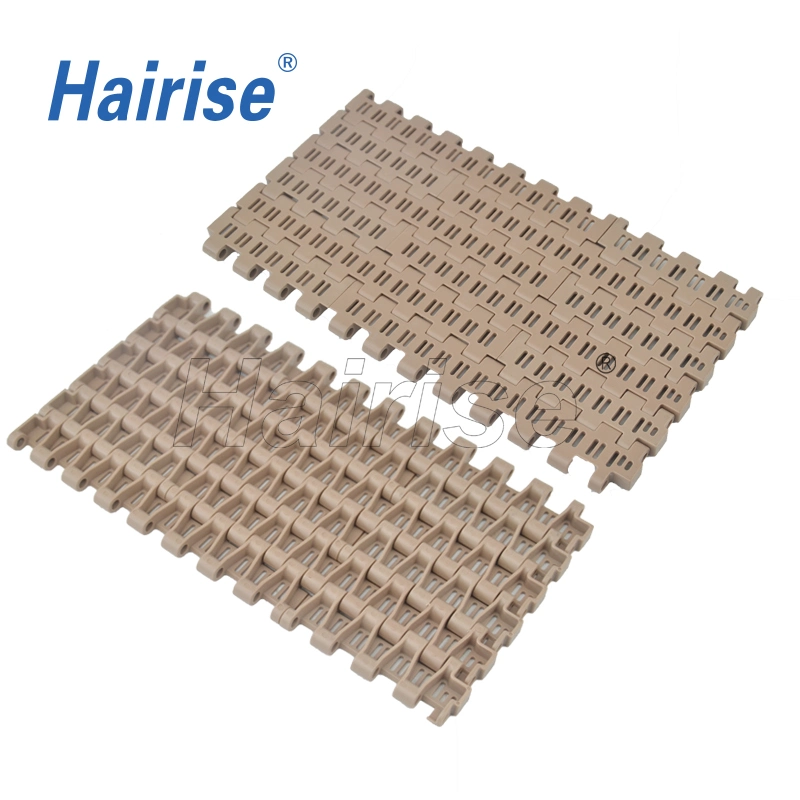
A slat top chain is a flat, heavy chain built of connected plates or "slats" linked to one another. These slats form a smooth, continuous surface that is ideal to transport bottles, boxes or any other element in a straight direction. Why choose a slat top chain?
● Strong and steady: Great for heavy loads that need solid support.
● Flat surface: Keeps products upright and in place.
● Easy to clean: Especially the stainless steel versions used in food and beverage industries.
● Long-lasting: Built to handle high-volume production with minimal wear.
● Bottling and canning lines
● Food and drink processing
● Cosmetics and personal care packaging
● Household product manufacturing
The slat conveyor chain is most at home in straight-line layouts. It’s a great choice when you need a reliable, no-nonsense system. Just keep in mind, it’s not made to curve or twist.
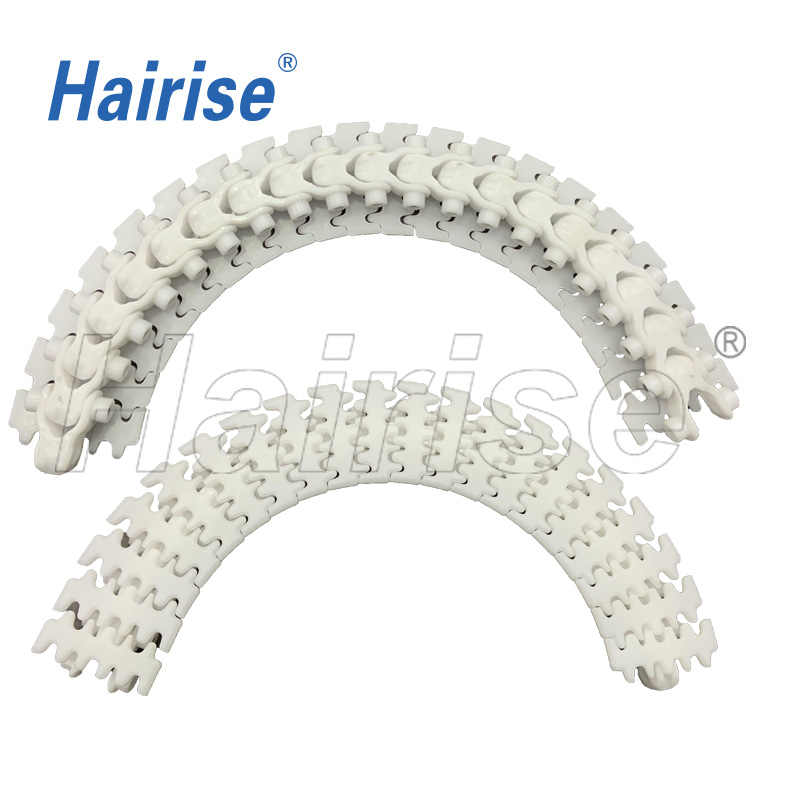
Now let’s talk about the chain that knows how to bend, literally. A flexible conveyor chain is constructed to work freely in bends, twistings and changes in elevation. It consists of short interconnected links, which enable the chain to bend side-to-side or up and down. Why flexible chains are a game-changer:
● Curves and corners? No problem! Flexible chains handle tight spaces with ease.
● Smooth operation: Reduces product slipping, even on turns or slopes.
● Modular design: Easy to install, expand, or change the layout.
● Space-saving: Great for compact production areas.
● Packaging lines with curves or inclines
● Warehouse systems with limited space
● Automated assembly lines
● Spiral conveyors and vertical lifts
Flexible chains are built for movement. If your line isn’t a straight shot, these chains help you make the most of your space without adding complicated equipment.
Not sure which chain fits your needs? Let’s break it down with some simple, real-world comparisons.
● If your conveyor system is straight and open, a slat chain is a solid choice. It’s simple and strong; no curves are needed.
● Tight on space? Need to go around corners? That’s where flexible conveyor chains shine. They let you build in tight spots and still keep things moving.
Quick Tip: Flexible chains are perfect for places where every inch counts.
● Got heavy items to move? Go with the slat chain. It offers solid support for bottles, metal parts, or full packages.
● Handling lighter goods or smaller items? Flexible chains are up to the task, especially if your line includes slopes or turns.
Rule of Thumb: Heavy = slat conveyor chain. Light + turns = Flexible chain.
● Slat top chains offer great control for high-speed lines. Their flat surface keeps products stable, even when things move fast.
● Flexible chains also do well at moderate speeds and are great for complex layouts. But at very high speeds, curves might require more careful design.
Bottom Line: For fast, straight runs, slat chain. For curved, custom layouts, flexible chain works best.
● Food and Beverage: Both chains can be used, but slat chains are easier to clean, especially metal ones.
● Cosmetics and Pharma: Need gentle handling with clean conditions? Either chain works, depending on the layout.
● Warehousing and Packaging: Flexible chains win in tight spots or multi-level setups.
Think About: Your product type, hygiene standards, and how much space you’ve got to work with.
So, what’s the real difference between the slat top chain and the flexible conveyor chain? It’s all about how they move and where they shine. Slat conveyor chains are best for straight paths, heavy loads, and high-speed lines. Flexible chains are your go-to for curves, compact areas, and custom layouts. There is no better or worse; it all depends on what your production line requires.
By putting the right chain with the right job, you will achieve a smoother-running chain and a longer life for your system as a whole. Still scratching your head? Don’t worry, Hairise has the expertise to help you pick the perfect chain for your business. Reach out today and let’s build a system that keeps your work flowing like clockwork.
Question 1. Can slat top chains handle curved layouts?
Answer: No, slat top chains are made for straight-line movement only. They don’t bend or curve, which makes them great for stable, flat paths.
Question 2. Which type is better for a compact production line?
Answer: Flexible chains are the best choice for tight spaces. They can curve, climb, and work around corners, saving space and reducing the need for extra machines.
Question 3. What materials are used in flexible chains?
Answer: Flexible conveyor chains are usually made from durable plastic, like POM or reinforced nylon. Some have stainless steel parts for added strength or special environments.
Question 4. Are both chains customizable for industry use?
Answer: Yes! Slat chains as well as flexible chains can be customized to suit various industries. Depending on what you need, you can select the materials, sizes and layouts.
LEAVE A MESSAGE
As a automation Conveyors Manufacturer, Plus Modular Belts and Components, Hairise is your right reliable and winning choice.

As a plastic conveyor belt manufacturer & modular conveyor belt supplier, Hairise is your right reliable and winning choice.

